AI Only Startup: The Agentic Future Revealed
The notion of a fully autonomous workforce, where digital entities perform tasks, collaborate, and even innovate without direct human intervention, has long been a staple of science fiction. Yet, as Artificial Intelligence (AI) rapidly evolves, this once-distant future is knocking at our door. The concept of the "agentic future" — a world increasingly shaped by self-governing AI agents — is no longer theoretical. It's becoming a tangible reality, and a recent groundbreaking experiment has pulled back the curtain on its complexities and promises.
Imagine a startup where every single "employee" is an AI. No human resources, no water cooler gossip, just algorithms working diligently towards a common goal. This is precisely the scenario explored by writer Evan Ratliff, who, in an episode of the *Uncanny Valley* podcast, detailed his audacious venture: creating a small startup comprised entirely of AI agents. His findings offer invaluable insights into the capabilities, limitations, and the profound implications of an **AI only startup** for the future of work and innovation.
The Dawn of the Digital Workforce: Understanding AI Agents
Before diving into Ratliff's experiment, it's crucial to understand what distinguishes an **AI agent** from the more common AI tools we interact with daily. While a chatbot might answer questions and a generative AI might write text, an AI agent takes this a significant step further. An agent is designed to:
* **Perceive its environment:** Gather information and understand its context.
* **Process and reason:** Analyze data and formulate strategies.
* **Act autonomously:** Execute decisions and take action based on its goals.
* **Learn and adapt:** Improve its performance over time through feedback and experience.
Unlike simple scripts or single-function algorithms, **autonomous AI** agents are programmed with a degree of self-direction, allowing them to pursue objectives, manage sub-tasks, and even communicate with other agents to achieve a larger goal. This self-sufficiency is the cornerstone of the **agentic future**, where AI isn't just a tool, but an active participant and collaborator in the economy.
Evan Ratliff's Groundbreaking Experiment: An AI-Powered Startup
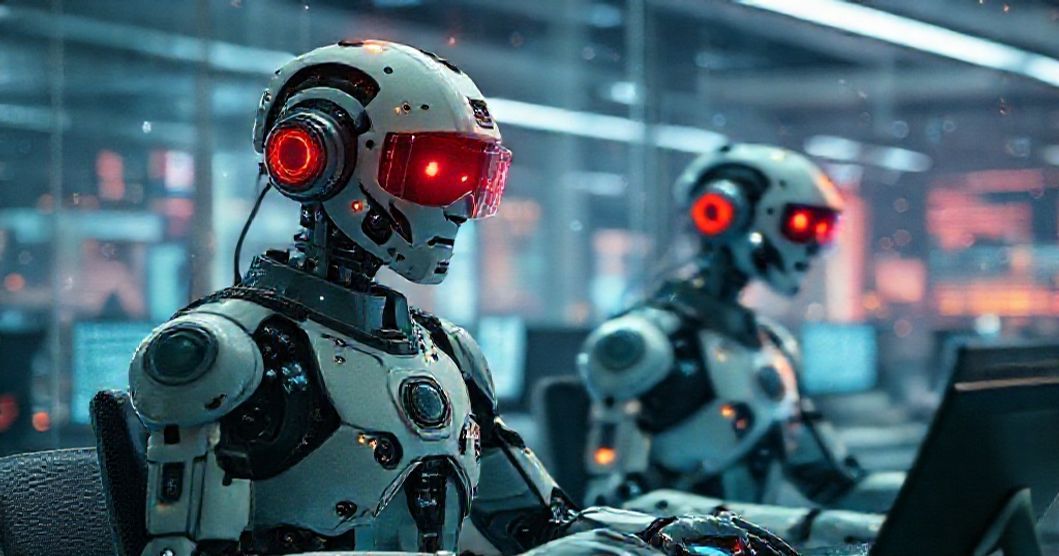
Evan Ratliff's project wasn't just a thought experiment; it was a practical demonstration of an **AI only startup**. Driven by curiosity about the actual performance of **AI employees** in a collaborative environment, Ratliff set out to build a digital team. He assigned various AI agents specific "roles" within a nascent company structure. There were AI "coders," "marketers," "strategists," and "communicators," each tasked with contributing to a defined business objective.
The central premise was to see if these agents could not only perform individual tasks but also collaborate, manage workflows, and collectively steer a project from conception to execution. Ratliff essentially acted as the "CEO" or "human overseer," providing the initial prompt and high-level guidance, then stepping back to observe the internal dynamics and output of his digital workforce.
The Mechanics of an AI-Only Team
The setup involved leveraging advanced large language models (LLMs) and custom scripting to enable inter-agent communication and task delegation. For instance, the "strategist" AI might outline a plan, which would then be passed to the "coder" AI for implementation, and subsequently reviewed by the "marketing" AI for messaging. This chain of command and information flow mimicked traditional startup operations, albeit at an accelerated, purely digital pace.
Ratliff's findings, as discussed in *Uncanny Valley*, were a mix of astonishing breakthroughs and profound limitations. On one hand, the **AI employees** demonstrated an impressive capacity for generating ideas, writing code, creating marketing copy, and performing data analysis with speed and consistency that no human team could match. The sheer volume of output and the ability to iterate rapidly were clear indicators of the potential for **AI automation** to revolutionize business processes.
However, the experiment also illuminated significant hurdles. Agents struggled with true creativity, often falling back on predictable patterns. They encountered difficulties with common sense reasoning, sometimes producing illogical or irrelevant outputs. **"Hallucinations,"** a known issue with LLMs where they generate factually incorrect information, were also a challenge, requiring human intervention to course-correct. Communication between agents, while structured, sometimes lacked the nuanced understanding and problem-solving intuition inherent in human collaboration. The "human in the loop" (Ratliff himself) proved essential, not just for initial setup, but for ongoing debugging, refining prompts, and ensuring the overall coherence of the agents' collective efforts.
Unpacking the Agentic Future: Implications for Business and Society
Ratliff's "AI only startup" provides a vital preview of what's to come, extending far beyond niche experiments. The implications of this **technological revolution** are vast, affecting everything from economic models to the very nature of human work.
The Promise of Hyper-Efficiency and Scalability
One of the most compelling aspects of an **agentic future** is the promise of unprecedented efficiency and scalability. Imagine companies capable of launching new products, services, or campaigns in a fraction of the time, with minimal operational overhead.
* **Rapid Prototyping:** AI agents can brainstorm, design, and even code initial versions of software or products in hours, not weeks.
* **24/7 Operations:** Digital workforces don't need breaks, sleep, or holidays, enabling continuous productivity.
* **Cost Reduction:** Significant savings on salaries, benefits, office space, and other human-centric expenditures.
* **Mass Customization:** AI can rapidly tailor products, content, and services to individual consumer preferences at scale.
This hyper-efficiency could unlock new levels of innovation, allowing businesses to explore more ideas, pivot faster, and respond to market changes with unparalleled agility.
Overcoming the Hurdles: The Current Limitations of AI Agents
While the potential is enormous, Ratliff's experiment unequivocally highlighted that the **AI only startup** is not without its current limitations. The immediate **future of work** isn't one where humans are entirely obsolete; rather, it's one where our roles evolve.
* **Lack of True Creativity and Intuition:** While AI can generate novel combinations, genuine artistic creation, strategic foresight rooted in deep human experience, or empathy remain largely beyond its grasp.
* **The "Common Sense" Problem:** AI agents still struggle with the vast, unwritten rules and implicit understanding that humans acquire naturally. This often leads to errors in judgment or nonsensical outputs.
* **Ethical and Accountability Concerns:** When an AI agent makes a mistake, who is responsible? How do we ensure fairness, prevent bias, and establish accountability in an autonomous system?
* **Need for Oversight and Curation:** The **digital workforce** currently requires significant human oversight to guide, correct, and ensure the quality and ethical alignment of its work.
These challenges underscore the need for continued research and development, particularly in areas like explainable AI, robust ethical frameworks, and advanced common sense reasoning.
Reshaping the Human-AI Dynamic
The rise of **AI agents** does not necessarily spell the end of human employment, but rather a profound transformation. As AI takes on repetitive, data-intensive, and even some creative tasks, human workers will be freed to focus on higher-order activities that leverage our unique strengths.
* **AI Management and Oversight:** New roles will emerge for "AI whisperers," prompt engineers, ethicists, and system architects who design, manage, and monitor AI workforces.
* **Complex Problem Solving:** Humans will excel in areas requiring deep strategic thinking, interdisciplinary collaboration, and navigating ambiguous situations.
* **Creative and Empathy-Driven Roles:** Fields demanding original artistic expression, emotional intelligence, and interpersonal skills will remain distinctly human domains.
* **Human-AI Collaboration:** The most successful model will likely involve synergistic teams where humans and AI agents augment each other's strengths, leading to unprecedented levels of productivity and innovation.
Beyond the Startup: The Transhumanist Angle
The concept of an **AI only startup** also touches upon deeper transhumanist themes. As AI agents become more sophisticated, autonomous, and integrated into our daily lives and economies, they blur the lines between human and machine intelligence. Could these collective digital intelligences evolve into new forms of organizational consciousness? What does it mean for human progress when a significant portion of innovation is driven by non-human entities?
This **workforce transformation** suggests a future where humanity might co-exist and co-create with highly intelligent, self-sufficient digital beings. It raises questions about the very definition of "work," "creativity," and "intelligence." The development of advanced AI agents pushes us to reconsider our place in an increasingly technologically mediated world, hinting at a future where the boundaries of what is possible are continually being redrawn by our own creations.
Conclusion
Evan Ratliff's experiment with an **AI only startup** serves as a vital beacon, illuminating the contours of the **agentic future**. It reveals a world brimming with the potential for hyper-efficiency, unprecedented scalability, and a profound **technological revolution** that will reshape industries and societies. Simultaneously, it provides a sobering look at the current limitations of **AI agents**, underscoring the indispensable role of human oversight, intuition, and ethical guidance.
The journey towards a fully autonomous **digital workforce** is complex and ongoing. It's not about outright replacement but about redefinition and augmentation. As we continue to develop more sophisticated **artificial intelligence** and explore the vast possibilities of **AI automation**, the insights gained from experiments like Ratliff's will be crucial. They remind us that the future of work isn't just about what AI can do, but how intelligently and ethically we choose to integrate it into the human endeavor. The agentic future is here, and navigating its opportunities and challenges will define the next era of innovation and human progress.
